Two scenes, one Wednesday
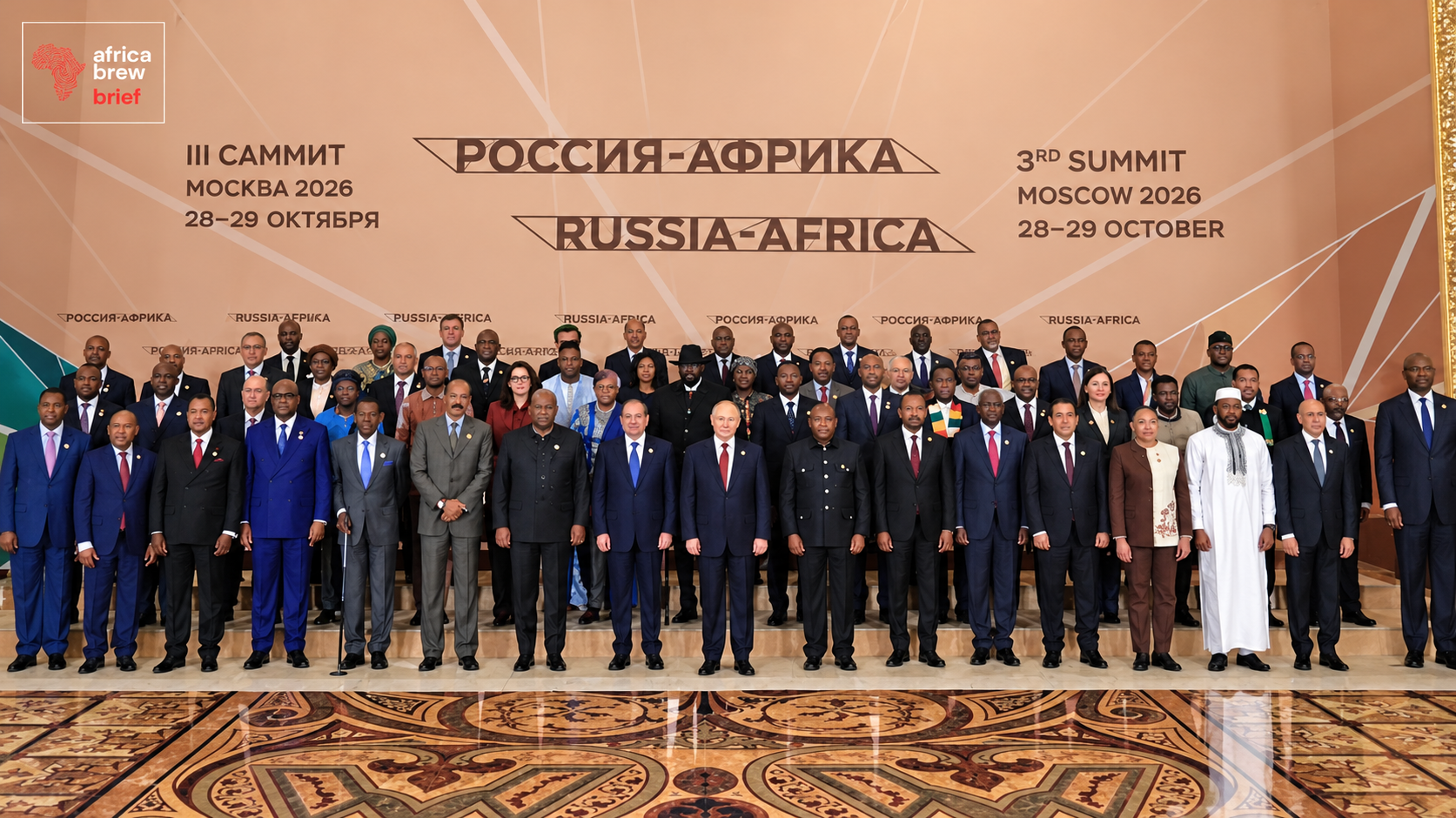
On Wednesday 28 October, under the chandeliers of the Grand Kremlin Palace, Vladimir Putin greeted African heads of state one by one as they arrived for the third Russia–Africa Summit. Ghana's John Dramani Mahama was among them, as a Reuters photograph showed.
Roughly 6,000 kilometres south, a different delegation was marching. That same day in Yaoundé, families walked to the Russian embassy to ask for their sons and brothers back from the war in Ukraine. The group, "Bring Back Our Sons and Brothers," was formed in August after the Cameroonian government confirmed that 16 of its citizens had died in the war. Families say some were promised civilian jobs and ended up on the front line. One woman told reporters she had not heard from her husband in nine months and wants the truth about his fate.
Hold those two pictures side by side. Everything else in this article sits between them.
The summit in numbers
The official framing was grand. The summit was held in the Grand Kremlin Palace, co-chaired by Putin and the African Union chair, Burundi's President Évariste Ndayishimiye, under the motto "For Peace, Security and Development." According to the Kremlin, 48 African countries took part, 22 of them represented by heads of state.
That headline number is a recovery, not a triumph. The first summit in Sochi in 2019 drew 43 African heads of state or government; St Petersburg in 2023, held after the invasion of Ukraine, drew only 17. Moscow has clawed back attendance, but it has not returned to its pre-war peak. Even the final count wobbled: by the close, Putin put the number of leaders at 21, according to Izvestia.
The location also tells a story. The summit was initially announced for Libya before being moved to Moscow. A summit meant to be hosted on African soil ended up, once again, with Africa travelling to Russia.
And then there is the number Moscow would prefer you not dwell on. In 2019, Putin set a target of $40 billion in annual trade with Africa. According to Kremlin aide Yuri Ushakov, trade topped $27 billion in 2025, still short of that target. Compare that with Beijing: China–Africa trade hit a record $348 billion in 2025, up 17.7% on the year. Russia's trade with Africa amounts to less than 8% of China's and less than 7% of the European Union's.
So the first uncomfortable truth: Russia is a political heavyweight in Africa and an economic middleweight.
Why Africa has become vital to Russia
Strip away the rhetoric and Russia needs Africa for six concrete reasons.
1. Votes and legitimacy. Africa holds 54 seats at the UN General Assembly, the largest regional bloc. For a country under sanctions and facing an International Criminal Court warrant against its president, a room full of African leaders is proof it is not isolated. Analyst Joseph Siegel put it bluntly on NPR: the main reason Russia holds these summits is to avoid international isolation, and Africa has mattered more to Moscow since the invasion of Ukraine than ever before.
2. A sanctions-proof payment system. This may be the most important outcome nobody is talking about. Putin told the summit the ruble now accounts for up to 85% of commercial payments between Russia and Africa. Each ruble transaction is a transaction outside the dollar system and outside Western financial surveillance. For Washington, the implications touch the dollar's international role and the effectiveness of financial sanctions.
3. Customers for what Russia still sells well. Grain, fertiliser, weapons and nuclear technology. Russian agricultural exports to Africa grew 35% in value in the first half of 2026, to $2.9 billion, with wheat shipments at record volumes. Putin said Russia sent 13 million tonnes of farm goods to African buyers between January and September. Africa is a cash market for Russian farmers and fertiliser oligarchs whose Western buyers have shrunk.
4. Resources. Uranium, bauxite, gold and critical minerals. Russian aluminium producer Rusal signed an MOU with Ghana to create a joint venture on extraction and processing. In Niger, reports emerged in mid-2024 that Rosatom was seeking to take over the uranium facilities and permits formerly held by France's Orano.
5. Security as an export product. Analyst Michele Kernitsky says Russia's main business in Africa is selling security, with the Africa Corps that replaced Wagner protecting juntas and embattled leaders in at least nine countries. Regime protection buys mining access, diplomatic loyalty and military basing.
6. Manpower. The question few governments want to say aloud. More on that below.
What Russia stands to gain from this summit
The Kremlin left Moscow with what it came for:
- A signed political text. The Moscow Declaration calls for a multipolar world order, greater African representation in global governance, and expanded cooperation in trade, energy, security and technology. Critically, it opposes unilateral coercive measures and the unlawful seizure of sovereign assets. Read that line carefully. "Unilateral coercive measures" is diplomatic language for Western sanctions, and "seizure of sovereign assets" refers directly to the frozen Russian central bank reserves in Europe. African leaders have now co-signed Russia's legal and diplomatic position on its own war financing.
- A three-year roadmap. The summit adopted a 2027–2029 action plan for the Russia–Africa Partnership Forum and a declaration on cooperation in civilian artificial intelligence.
- A permanent seat at Africa's security table. The declaration proposes a permanent high-level Russia–Africa dialogue on counter-terrorism, food security and information security. "Information security" deserves scrutiny: in Moscow's vocabulary, it often means state control over online content.
- Nuclear lock-in. All signatories committed to more cooperation on peaceful nuclear energy, including uranium extraction and processing, building nuclear plants of various sizes and supporting the life cycle of existing facilities.
What Africa stands to gain
It would be lazy journalism to pretend Africa walked away with nothing. The real gains are these:
- Food and fertiliser security. PhosAgro said it expects to double its total annual deliveries to Africa in 2026 compared with last year. This matters more than usual because the war pitting the United States and Israel against Iran has also disrupted fertiliser supplies. Moscow has also proposed building fertiliser production facilities inside Africa rather than relying solely on exports from Russia. If that happens, it is the single most valuable thing on the table for African agriculture.
- Energy ambition. On 28 October, Rosatom signed a memorandum with Togo's energy ministry covering nuclear power and other uses, and Ghana opened talks on its first nuclear plant. Rosatom is already building Egypt's El-Dabaa nuclear plant.
- Regional frameworks. Russia signed an action plan on cooperation with SADC covering agriculture, trade, energy and mining.
- Education. Putin said about 40,000 Africans study at Russian universities, and he pledged to increase the number of African students in Russia on both paid and state-funded places.
- Leverage. The most underrated gain. Intensifying competition between Russia, China, the United States and the European Union could widen African governments' negotiating options. Every Moscow summit raises the price Washington, Brussels and Beijing must pay for African attention.
The reality check: paper versus projects
Here is where the investigative lens matters. The summit produced some deals, but they are memorandums of understanding or cooperation agreements rather than firm investments. AFP reported the Kremlin expected 33 documents to be signed, and their value will depend on financing, obligations and implementation timetables.
The nuclear record is the starkest test. Chatham House noted that Russia has signed nuclear cooperation agreements with at least 15 African states, and none has yet become a completed project. Its overall verdict was that, with the war in Ukraine still constraining Russia's resources, the summit is unlikely to change these fundamental dynamics.
Even the Togo deal, on closer reading, is preliminary: Rosatom agreed with Togo to set up a working group to assess possible nuclear opportunities. A working group is not a power station.
The war in the room that the declaration did not mention
The darkest thread running through this summit is the recruitment of Africans into Russia's army.
According to Ukraine's Foreign Ministry, at least 2,982 people from 37 African countries were in active service on Russia's side as recently as August. Ukrainian and human rights monitoring data put at least 486 African recruits confirmed killed by August this year. A separate Journalists for Justice investigation documented 502 African deaths by June 2026. In Kenya, petitioners told the Senate this month that 841 Kenyans were involved in the war.
These figures come largely from Ukraine, a party to the war, and Russia denies illegal recruitment. But independent groups are reporting the same pattern. Amnesty International sent an open letter to attending leaders urging them to demand an end to what it called deceptive and coercive recruitment of Africans to fight for Russia.
Some leaders did raise it, privately. Putin was silent on Kenyan President William Ruto's request for help repatriating Kenyans recruited into the Russian army, and Nigerian and South African officials also voiced concern. Publicly, the record is blank: the Globe and Mail noted the summit itself said nothing officially about the conscripts.
A declaration that found room for artificial intelligence, piracy and UN Security Council reform found no room for African men dying in Ukrainian trenches.
The security bargain: who is protecting whom?
Moscow sells itself as the partner who delivers security where France failed. The 2026 record complicates that. In April, Russia's Africa Corps confirmed it had withdrawn from Kidal in northern Mali after fierce fighting, following coordinated attacks by the Tuareg-led FLA alongside West Africa's al-Qaeda affiliate. Rebels announced a negotiated deal allowing the Africa Corps to leave the town. The town was later retaken: in early October 2026 the FLA pulled back and Kidal returned to Malian army control.
Meanwhile, critics allege abuses. Ukrainian official Anton Gerashchenko cited Human Rights Watch's October documentation of new torture cases against civilians involving Africa Corps fighters.
And here is a statistic that shatters a popular myth. Over 2021–2025, the United States supplied about 19% of Africa's major weapons imports, China 17%, Russia 15% and France 8.3%. Russia is not even Africa's largest arms supplier. Its influence comes less from volume than from what it is willing to do: protect governments that others will not.
How this affects the United States, Europe and China
The United States. Washington's problem is absence. NPR reported that Moscow's anti-Western message has gained ground, especially in the Sahel, with Russia filling the vacuum, and that a number of US embassies in Africa are without ambassadors. The US is focusing on strategic resources and supply-chain security, essentially critical minerals. The ruble's rise in Russia–Africa settlement is a slow erosion of the sanctions toolkit. America cannot compete for influence on a continent where it does not show up.
Europe. For Brussels and Paris, the summit is a mirror. France was expelled from the Sahel; as one analysis put it, France was pushed out and Russia stepped in. Europe is Africa's biggest trading partner and largest aid donor, yet it is losing the narrative war. The Russian Foreign Ministry claims Western governments pressured African states to skip the summit, a claim that conveniently portrays any Western diplomacy as neo-colonial. The deeper European risk is the declaration's language on frozen assets: Africa now sits, on paper, on Moscow's side of that fight. And one analyst argues Europe's bandwidth for Africa is being squeezed by its focus on Ukraine and the Middle East.
China. Beijing is the quiet winner. China pioneered the summit format in 2000 and remains Africa's largest trading partner, with Russia's efforts paling in comparison. Russia's sanctions-busting payment rails, anti-Western rhetoric and security operations all reduce Western leverage, which benefits Beijing without Beijing spending a cent. But China has its own Africa problem: its record trade came as the deficit ballooned, and Africa still mostly sells China raw materials rather than manufactured goods. Moscow's "we process locally" pitch is aimed as much at Beijing as at Paris.
The questions no one in the Kremlin hall asked
A world-class summit deserves world-class scrutiny. These are the questions African citizens, journalists and investors should be putting to their governments this week.
- Did any African president sign a declaration defending Russia's frozen assets while their own citizens' bodies remain unrecovered in Ukraine? If yes, what did they get in exchange?
- What do African exporters do with rubles? If up to 85% of trade settles in rubles, and Russia sells Africa far more than it buys, African importers become ruble buyers and African exporters gain little. Who holds the currency risk?
- Why are we buying nuclear plants we cannot refuel ourselves? Rosatom proposes floating nuclear plants under power purchase agreements, with servicing and refuelling done in Russia, and units operating for up to 60 years. That is a 60-year energy dependency on a single foreign state. Who pays if sanctions block the refuelling ship?
- Who audits the security bargain? If Africa Corps protects a government, who holds that force accountable for civilian deaths? Does any parliament in the Alliance of Sahel States see the contract?
- Where is the 2023–2026 action plan's scorecard? Africa has signed a new three-year plan. Has anyone published what the last one actually delivered?
- Why is the trade target still unmet seven years later? If $40 billion was promised in 2019 and $27 billion arrived in 2025, why should 2029 promises be believed?
- Are African leaders being used as a peace-washing backdrop? Mahama said before travelling that he would try to convince Putin to agree a ceasefire if he could. In 2023, African leaders presented a peace plan, too. What has Africa's peace diplomacy produced in three years?
- What does "information security" cooperation mean for African journalists and opposition voices? Will Russian systems for online control be exported alongside Russian wheat?
- Is anti-colonial rhetoric being used to sell a new dependency? Putin told the summit that Russian business does not engage in predatory, neo-colonial exploitation. Then why are mineral rights, regime protection and long-term energy contracts at the heart of the package?
- Would we accept these terms from Paris or Washington? This is the test that cuts through everything. If an African government would protest a Western power for the same deal, it should protest Moscow too.
What African leaders must watch out for
- MOU inflation. Signing ceremonies are not investments. Demand financing terms, timelines and penalties.
- Debt by another name. Nuclear plants are financed with huge state loans. El-Dabaa should be studied in full before any other country signs.
- Single-supplier lock-in. Fuel, spare parts and security services from one sanctioned state create concentration risk.
- Sanctions spillover. Banks, insurers and shippers handling ruble trade can face secondary sanctions. African firms, not Russian ones, will carry that risk.
- Mineral deals without processing clauses. Hold Moscow to its own promise: if Russia claims it processes locally, write local refining into every contract.
- Citizen protection. No more agreements should be signed while recruitment networks operate in African cities. Repatriation and anti-trafficking cooperation should be a condition, not an afterthought.
- Losing the non-aligned position. Mahama described Ghana's policy as being friends to all and enemies to none. That is the right instinct. Co-signing language on frozen assets and sanctions edges away from it.
The Brew Brief verdict: who won?
Russia won the photograph. It proved it is not isolated, recovered from 2023's embarrassing turnout, locked in a three-year framework, expanded its ruble payment system, and got African signatures on language that serves its war-financing interests.
Africa won options, not outcomes. Fertiliser and grain flows are real and needed. Nuclear and mining deals are possible but unproven. The leverage gained against Washington, Brussels and Beijing is genuine, if African leaders know how to use it.
The losers are the ones who were never in the room: the Cameroonian wife waiting nine months for news, the Kenyan families with petitions to the Senate, the Malian villagers living under foreign forces no parliament supervises.
One security analysis concluded the summit was unlikely to be either a decisive Russian breakthrough or a purely symbolic exercise. That is correct, and it is exactly why it demands scrutiny. Partnerships that are neither empty nor transformative are the ones that quietly reshape a continent while nobody is watching.
The agribusiness angle for Brew Brief readers
For traders, processors and investors in our network, three things matter most:
- Fertiliser pricing. Expanded Russian supply, combined with Gulf disruption, could ease input costs for African farmers in the 2027 season. Watch for local blending or production plants that move from MOU to ground-breaking.
- Wheat dependency. Record Russian wheat flows are good for bread prices in the short run and bad for Africa's own cereal ambitions in the long run. Cheap imports can undercut local millers and farmers.
- Payment risk. If you trade with Russian counterparties, understand ruble settlement, correspondent banking and secondary sanction exposure before signing. Your bank may refuse the transaction even if your government signed the declaration.
Africa Brew Brief will track the 33 documents signed in Moscow and report back on which ones become funded projects.